Junseong Lee

Research

A crawlable index of research work, papers, and public repositories.

BiomeTrail: a provenance-gated biomedical knowledge graph
Open BiomeTrail
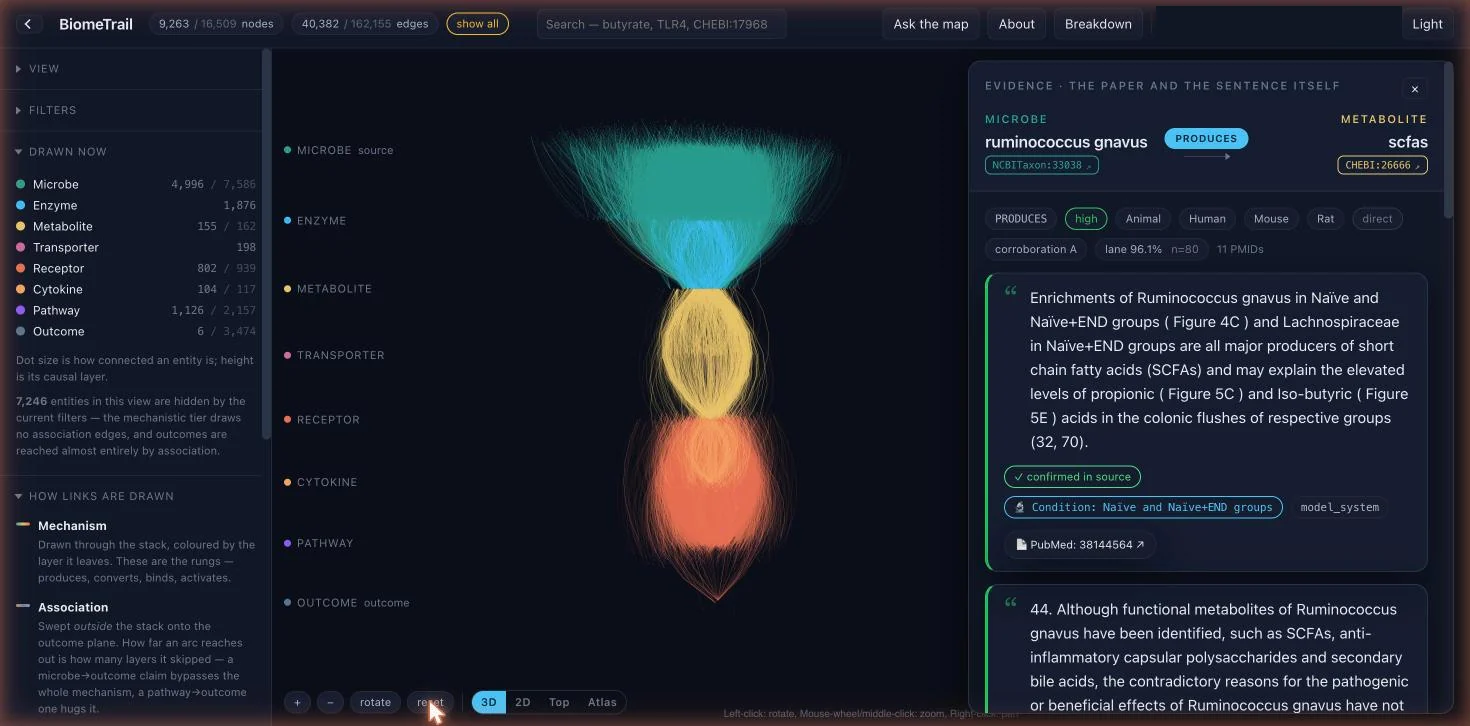
BiomeTrail interface: a 3D typed knowledge graph on the left, and an evidence panel on the right showing a microbe-produces-metabolite edge with its grounded identifiers, verbatim source sentence, and PubMed citation.

A knowledge graph of the microbe to host interface — microbe, metabolite, receptor, pathway, outcome — built at LMIC (Massachusetts General Hospital / Harvard Medical School). Every edge keeps the source sentence that justified it, with its PMID and both endpoints grounded to standard ontologies, so a claim can be checked link by link rather than taken on trust. Two papers from this work were accepted as posters at NeurIPS 2026 workshops, with a journal manuscript in preparation.

Papers from this work
  • Demo: Preserving Evidence, Context, and Disagreement in Mechanistic Microbe-Host Graph QA — NeurIPS 2026 Workshop GenAI4Health · Demonstration Paper Track · Poster
  • Bounded Verification and Asymmetric Recoverability in Biomedical Knowledge-Graph Construction — NeurIPS 2026 Workshop AI4Science · Poster

Junseong Lee, Young-Tak Kim, Hyunji Kim, Niranjan Kulkarni, Emma Skybova, Victoria Kim, Jonathan Sheejin Choi, Synho Do
Expertise modulates automation bias and sentinel behavior in human-AI collaborative diagnosis of neonatal pneumoperitoneum

Open PublicationOpen Repository
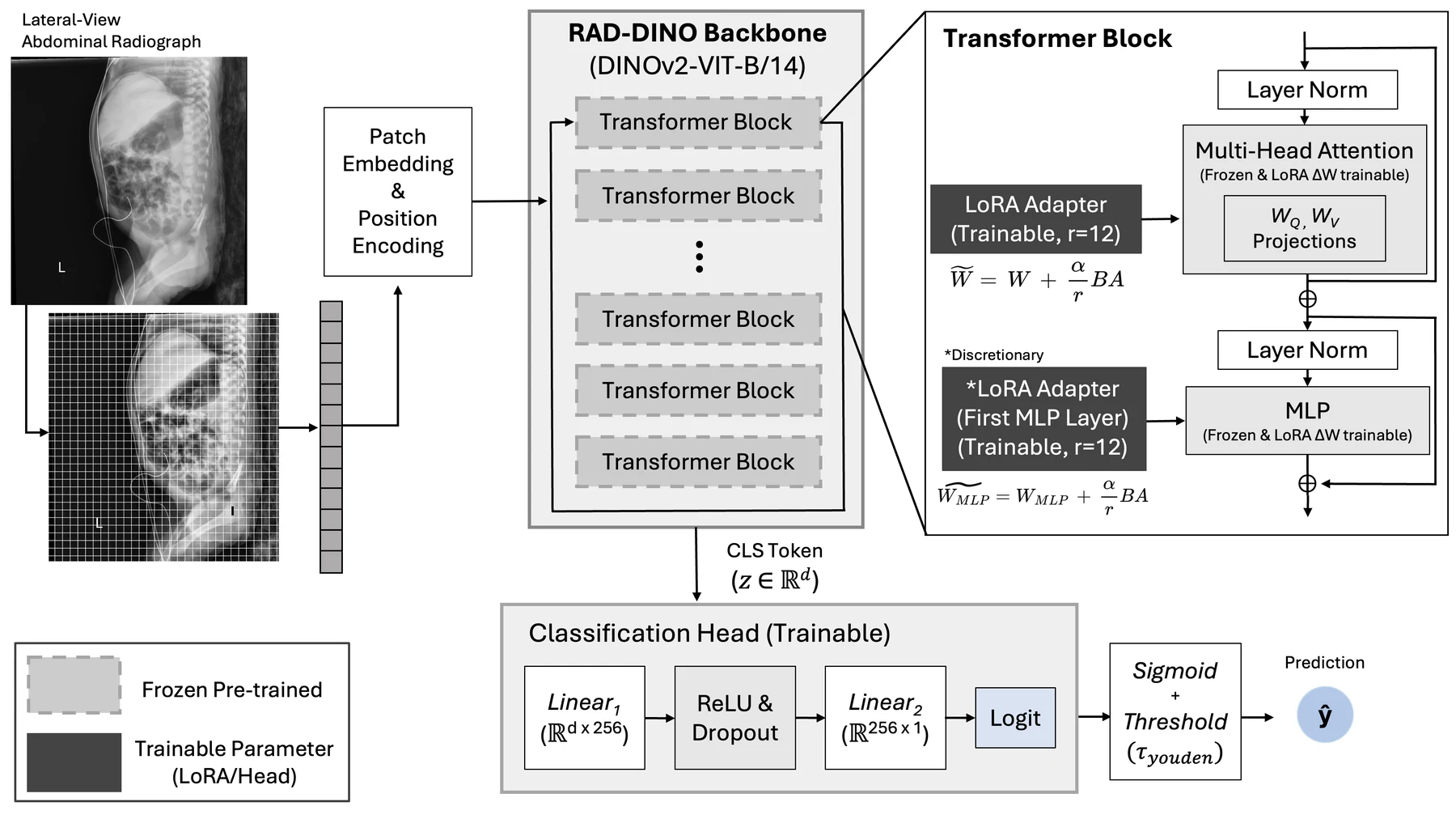
Model architecture: a lateral-view abdominal radiograph is patch-embedded into a frozen RAD-DINO (DINOv2 ViT-B/14) backbone whose transformer blocks carry trainable LoRA adapters on the query and value projections; the CLS token feeds a trainable two-layer classification head ending in a sigmoid with a Youden threshold.

A multi-reader, multi-case crossover study of how radiologists of differing expertise respond to a reliable versus an error-injected AI collaborator on cross-table lateral radiographs. The model is RAD-DINO (DINOv2 ViT-B/14) adapted with LoRA adapters (r=12) on the frozen backbone plus a trainable classification head, reaching AUC 0.948 on multi-center external validation. Published in npj Digital Medicine; the public repository is the official codebase and links the open educational sandbox where students and residents practice AI-collaborative cognitive conflicts. Presented at RSNA 2025.

Automated landmark detection and view positioning assessment of shoulder Grashey view radiographs using cascade deep learning: A dual-center validation study

Open Publication
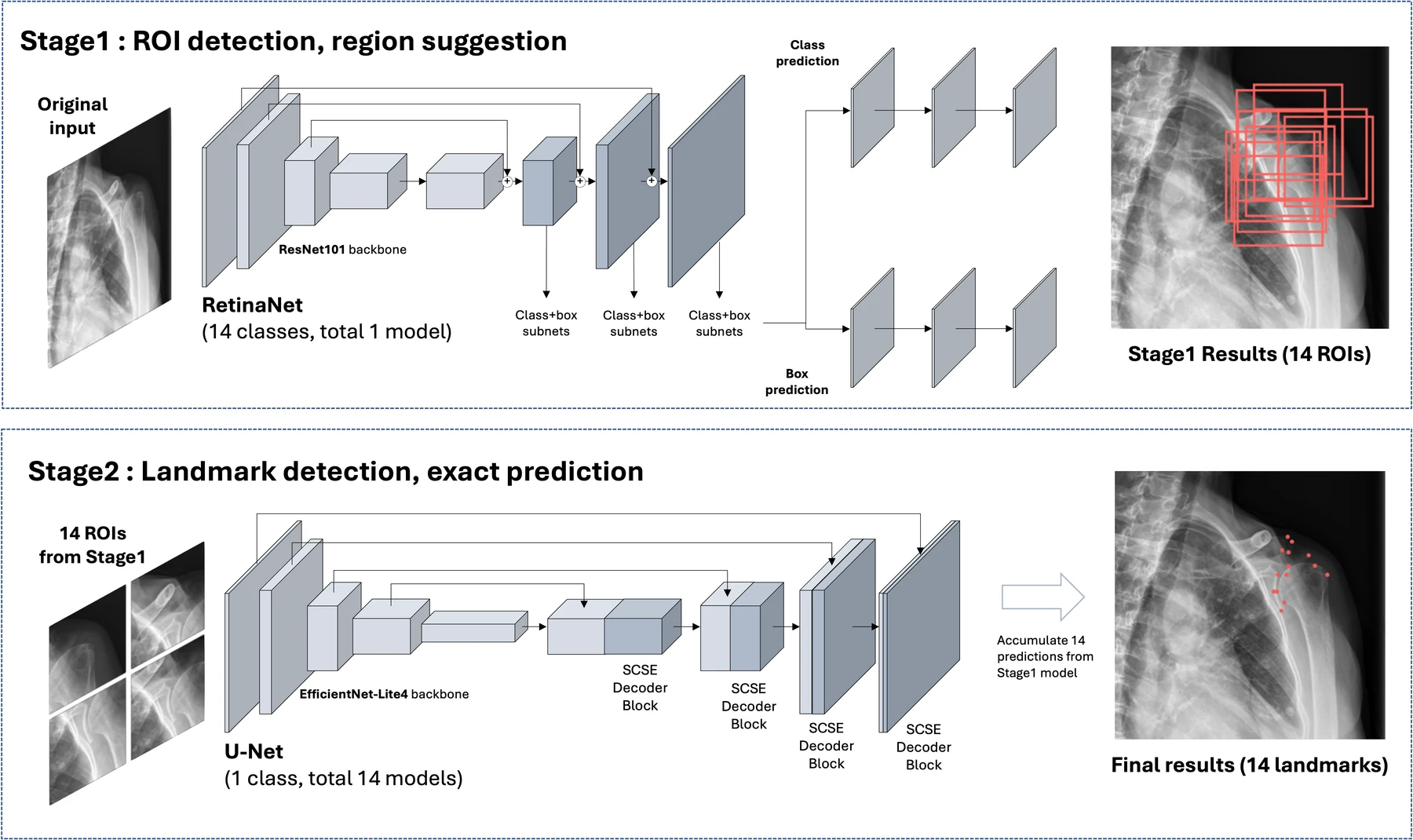
Two-stage cascade: stage 1 is a RetinaNet with a ResNet101 backbone detecting 14 regions of interest on a shoulder radiograph; stage 2 runs a U-Net with an EfficientNet-Lite4 backbone and SCSE decoder blocks per ROI, accumulating 14 landmark predictions.

Co-authored paper on a cascade deep learning framework for shoulder Grashey radiographs. Stage 1 uses RetinaNet with a ResNet101 backbone to propose 14 anatomical regions of interest; stage 2 runs a U-Net with an EfficientNet-Lite4 backbone and SCSE decoder blocks over each ROI, accumulating 14 landmark predictions that are then used to score view positioning. Validated across two centers.